Mandibular Reconstruction Plates are critical devices in restoring jaw continuity, facial symmetry, chewing, and speech after tumor surgery, trauma, or severe infection. Their design must tolerate strong bite forces while fitting irregular bone contours. Small differences matter. A misplaced screw can affect occlusion, soft tissue healing, or future dental rehabilitation.
Industry reports show a growing demand for craniofacial and orthopedic implant technologies. Grand View Research identifies rising reconstructive surgery volumes, additive manufacturing, and patient-specific planning as major market drivers. MarketsandMarkets also highlights digital workflow integration and customized implants within the broader orthopedic trauma devices sector. However, most commercial reports do not isolate Mandibular Reconstruction Plates as a separate category. That limitation deserves attention.
Clinical quality remains more important than a manufacturer’s ranking. Professor Rui Fernandes, a recognized maxillofacial reconstruction specialist, has described the central objective as restoring “form, function, and facial symmetry.” This principle should guide any comparison of China’s leading manufacturers. Material traceability, titanium grade, plate fatigue resistance, bending performance, screw compatibility, sterilization controls, and ISO 13485 certification require careful review.
Factory capability is only one part of the decision. Surgeons also need dependable imaging support, responsive engineering teams, documented quality systems, and consistent batch inspection. A polished catalog cannot replace clinical evidence. Nor can a low quoted price prove long-term value. This overview examines prominent Chinese manufacturers through those practical criteria, while recognizing that available public data remains uneven and sometimes incomplete.
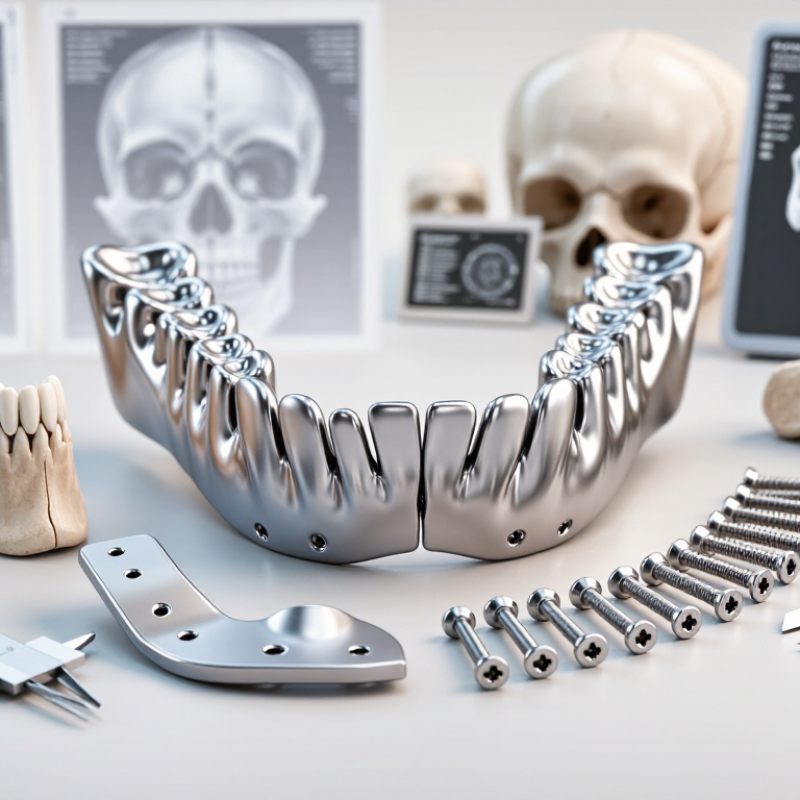
Mandibular Reconstruction Plates: Purpose, Design, and Clinical Applications
Mandibular Reconstruction Plates: Purpose, Design, and Clinical Applications
Mandibular reconstruction plates restore continuity after tumor removal, severe trauma, infection, or bone loss. They support chewing, speech, facial symmetry, and soft-tissue healing. A 2023 report from Grand View Research estimated the global craniomaxillofacial implants market at over USD 2 billion, reflecting rising reconstructive demand. However, market size does not prove clinical superiority.
Modern plates commonly use titanium because it offers strength, corrosion resistance, and suitable biocompatibility. Design choices include locking screws, variable hole patterns, low-profile edges, and pre-contoured shapes. Locking systems can reduce plate-screw loosening, especially when bone quality is poor. Digital planning and patient-specific bending may improve fit, yet they cannot replace surgical judgment. A 2022 systematic review in the International Journal of Oral and Maxillofacial Surgery reported that complication rates remain influenced by infection, smoking, radiation exposure, and soft-tissue coverage. The plate is only one part of reconstruction. Sometimes, design assumptions fail.
Tips: Evaluate fatigue strength, screw compatibility, contour accuracy, and sterilization documentation. Ask for mechanical test methods, not only headline specifications. Review clinical evidence involving similar defects and graft conditions. Manufacturing consistency matters; ISO 13485 certification supports quality control, but it does not guarantee every clinical outcome. In my experience, the most practical selection balances anatomy, fixation strategy, surgeon handling, and long-term follow-up data.
Key Standards for Evaluating Chinese Plate Manufacturers
Top China Mandibular Reconstruction Plates Manufacturers?
Evaluating Chinese mandibular plate manufacturers requires more than comparing prices or polished catalogs. WHO’s Global Atlas of Medical Devices describes more than two million medical device types worldwide. This scale makes supplier verification essential. Request ISO 13485 certification, product-scope details, and recent audit findings. Certification alone is not enough.
Review material controls for titanium alloy, including chemical composition, mechanical testing, and surface finishing. ASTM F382 provides a recognized method for testing metallic bone plates. ASTM F543 also supports evaluation of bone screws. Ask for batch records, dimensional inspection reports, and sterilization compatibility data. Traceability matters. Each plate should connect to a material lot, operator, inspection result, and release decision.
Clinical and regulatory evidence deserve equal attention. Confirm the manufacturer’s NMPA registration status and technical documentation. Check whether design validation reflects mandibular loads, contouring, screw-hole strength, and repeated bending. ISO’s 2023 Survey recorded more than 38,000 ISO 13485 certificates worldwide, but certificates do not prove clinical suitability. Request complaint trends, corrective-action records, and post-market surveillance data. A clean presentation can still hide weak testing. This is where many evaluations become subjective. No scorecard is perfect. Use independent testing when claims remain unclear. Assess communication quality too, because slow responses can delay deviation handling and surgical planning.
Top China Mandibular Reconstruction Plate Manufacturers: Key Standards for Evaluating Chinese Plate Manufacturers
This chart presents a practical evaluation-weight framework for mandibular reconstruction plate suppliers. The criteria are based on internationally recognized requirements, including ISO 13485 for medical-device quality management, ISO 14971 for risk management, ISO 10993 for biological evaluation, ISO 5832-3 for titanium alloy material specifications, and ISO 11135 or ISO 11137 for sterilization validation. The percentages are assessment weights, not company-specific performance claims.
Leading China-Based Mandibular Reconstruction Plate Manufacturers
China-based mandibular reconstruction plate manufacturers are gaining attention for flexible production and competitive engineering support. Leading suppliers often combine titanium processing, precision machining, and patient-specific design capabilities. Their teams may review CT-based models with surgeons before shaping a plate. Small contour changes can affect fixation, soft-tissue coverage, and operating time.
Clinical experience matters. A capable manufacturer should understand screw-hole positioning, plate thickness, bending limits, and sterilization requirements. It should also provide material certificates, dimensional inspection records, and complete product traceability. Ask about ISO 13485 certification, risk management, and applicable regulatory registrations. These documents need independent verification. Marketing language alone is not enough.
Samples reveal practical quality. Check edge finishing, hole consistency, surface appearance, and compatibility with planned screws. Communication also deserves attention. Clear drawings, controlled revisions, and responsive technical support can prevent costly misunderstandings. No factory is perfect. I would still expect suppliers to explain limitations honestly, especially when custom designs require additional validation. Site audits, pilot orders, and documented corrective actions offer stronger evidence than impressive brochures. Surgical decisions must remain with qualified medical professionals and follow local requirements.
Manufacturing Technologies and Quality Control Practices
Top China Mandibular Reconstruction Plates Manufacturers?
Manufacturing Technologies and Quality Control Practices
Leading Chinese mandibular plate manufacturers increasingly combine digital design, CNC machining, laser cutting, and additive manufacturing. CT-based planning can convert a patient’s anatomy into a precise three-dimensional plate model. Titanium alloys remain common because they offer strength, corrosion resistance, and acceptable biocompatibility. A 2024 Grand View Research report estimates the global cranio-maxillofacial implants market at more than USD 1 billion, with continued growth linked to patient-specific reconstruction. That growth raises expectations for repeatable production.
Quality control should begin with raw-material verification. Manufacturers need documented alloy certificates, heat numbers, and supplier audits. Coordinate measuring machines can check screw-hole positions and plate curvature. Industrial CT scanning may identify internal pores in additively manufactured parts. Surface roughness testing also matters, especially around fixation holes and bending zones. ASTM F382 provides a recognized framework for testing metallic bone plates, while ISO 10993 supports biological safety evaluation. Traceability matters.
ISO 13485 certification is useful, but it is not proof of perfect clinical performance. Auditors should review nonconformity records, fatigue-test results, sterilization validation, and corrective actions. Packaging inspections deserve equal attention. Tiny scratches can become failure points. No factory is perfect. Some production lines still rely heavily on manual polishing, which may create variation between batches. Procurement teams should therefore request batch-level measurements, retained samples, and evidence of design verification rather than relying only on certificates or impressive factory tours.
How to Select a Suitable Mandibular Plate Supplier in China
Top China Mandibular Reconstruction Plates Manufacturers?
Selecting a suitable mandibular plate supplier in China requires more than comparing prices. Start by checking whether the manufacturer understands clinical needs, including segmental defects, bone thickness, and screw placement. Request material details, such as implant-grade titanium specifications, surface treatment, and mechanical test results. The supplier should also explain how plates are designed from CT data and adjusted for patient anatomy.
Ask for evidence of a controlled quality system, traceable production records, and relevant regulatory documentation for your target market. Manufacturing experience matters. Review sample plates for edge smoothness, hole consistency, bending performance, and packaging condition. Small defects can create serious surgical concerns. Clear communication is essential, too. Engineers should answer technical questions directly, not hide behind sales language.
Request anonymized case references or validation reports where legally appropriate. Check whether the supplier can provide stable lead times, inspection records, and responsive after-sales support. A reliable partner should discuss customization limits honestly. Cheap tooling may look attractive, but poor dimensional control can increase clinical risk and waste time. No checklist is perfect. I would still ask an independent biomedical or regulatory specialist to review the supplier before approval. The strongest choice is usually not the cheapest one, but the manufacturer that combines evidence, consistency, and practical support.
FAQS
It restores jaw continuity after tumor removal, severe trauma, infection, or major bone loss. It supports chewing, speech, facial symmetry, and soft-tissue healing.
Titanium alloys are common because they provide strength, corrosion resistance, and suitable biocompatibility. Material choice still depends on the patient and surgical plan.
Locking screws may reduce loosening when bone quality is poor. Low-profile edges can reduce soft-tissue irritation. Pre-contoured shapes may improve fitting.
No. CT-based planning and patient-specific bending can improve fit, but they cannot replace surgical judgment. Sometimes, design assumptions fail.
Request alloy certificates, batch traceability, dimensional measurements, fatigue testing, sterilization validation, and corrective-action records. Certificates alone are not enough.
Incorrect screw holes can weaken fixation. Tiny scratches may become fatigue points. Manual polishing can also create differences between batches.
Review mechanical test methods and clinical evidence involving similar defects, graft conditions, and fixation strategies. Impressive specifications may hide important gaps.
Infection, smoking, radiation exposure, poor soft-tissue coverage, and weak bone can increase complications. The plate is only one part of reconstruction.
No. Certification supports manufacturing control, but it cannot guarantee every clinical outcome. Long-term follow-up remains important.
Balance anatomy, screw compatibility, contour accuracy, fatigue strength, surgeon handling, and follow-up evidence. The perfect choice may not exist.
Conclusion
Mandibular Reconstruction Plates are essential medical devices used to stabilize and support the jaw after trauma, tumor removal, congenital conditions, or other reconstructive procedures. Their design must balance strength, anatomical adaptability, biocompatibility, and ease of surgical placement. Important features may include accurate contouring, secure fixation options, appropriate thickness, and compatibility with related instruments and imaging requirements.
When evaluating Chinese manufacturers, buyers should consider material traceability, engineering capabilities, production consistency, sterilization arrangements, inspection procedures, and compliance with applicable medical-device standards. Reliable suppliers typically maintain rigorous quality-control systems covering raw materials, machining, surface finishing, dimensional accuracy, packaging, and batch documentation. Selecting a suitable supplier also requires reviewing customization capacity, technical communication, delivery reliability, after-sales support, and experience with clinical requirements. A structured comparison of these factors can help hospitals, distributors, and medical-device purchasers identify a dependable manufacturing partner while supporting patient safety and consistent surgical outcomes.
 Osteora
